Introduction
Modular has a set of GPU puzzles for their open-source systems language called Mojo that I have been working on to get more familiar with the language. I will write a longer post about my thoughts on Mojo later as I get more comfortable with it, but I thought I would write down my notes / worklog while working on these puzzles.
My solutions are available here.
GPU Basics
Problem 1: Map
- Use
unsafe_offsetfor pointer arithmetic TileTensormakes index math (N-dim arrays, strides, padding, offsets) so simple- When writing
wgslkernels for llama.cpp and onnxruntime-web, this could be a big pain
- When writing
Problem 2: Zip
- There is an
unsafe_pointerclass for raw memory accesses, including GPU memory - A
blockis another word for aworkgroup
Problem 3: Guards
- GPU threads are cheap to launch, and kernels work most efficiently with certain block sizes (e.g. 32, 64)
- So launching extra / unused threads is fine for perf, but you still have to ensure correctness
- Gets more complex with 2D or 3D tensor layouts
- This is a fundamental pattern in GPU kernels
Problem 4: 2D Map
- Again, 2D indexing is easier with
TileTensors
Problem 5: Broadcast
- broadcasting := reshaping lower-dim arrays to match higher-dim arrays for elementwise operations
Problem 6: Blocks
- Blocks / workgroups are software abstractions
- Warps / subgroups (wgsl) are actual hardware units of threads that execute together
- The warp scheduler assigns warps to execute workgroups
- We can have multi-dimensional workgroups (3D in WGSL), and we use the same N-d indexing for workgroups as for tensors (nice!)
Problem 7: 2D Blocks
- No notes
Problem 8: Shared memory
- Workgroups have memory shared by all threads
- cooperative load := threads in a block cooperate to store values
- barrier := synchronization point for threads in a workgroup
Problems 9, 10
- I had to skip these problems since they were only for NVIDIA GPUs
Problem 11: Pooling
- Sliding window is a common pattern in GPU kernels, like applying a convolution filter
- Leetcode came in handy after all!
- Don’t forget to apply filters across cross-block values!
Problem 12: Dot Product via Parallel Reduction
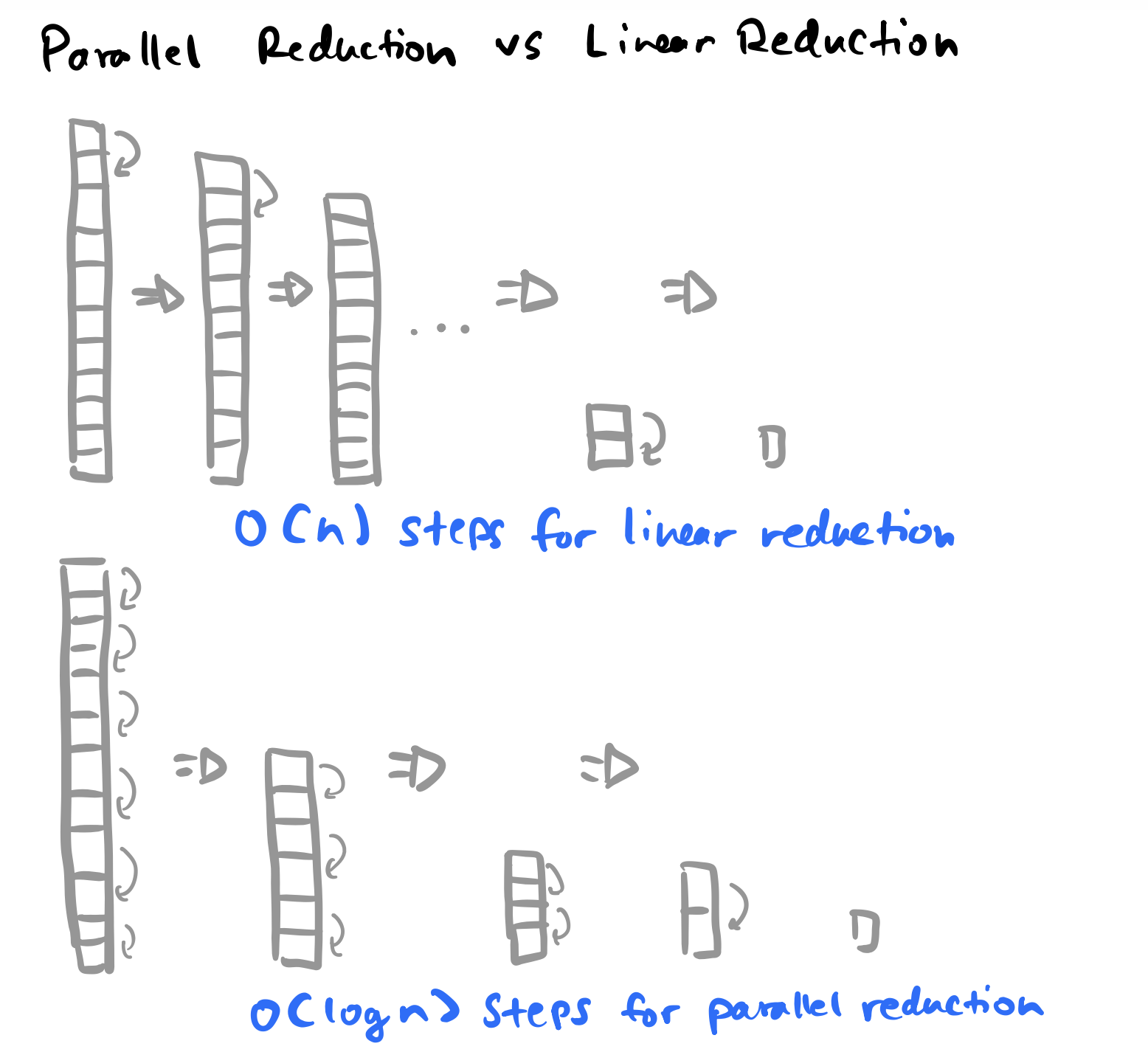
- Instead of reducing sequentially like in a single-threaded program, you can reduce in parallel!
Problem 13: 1D Convolution
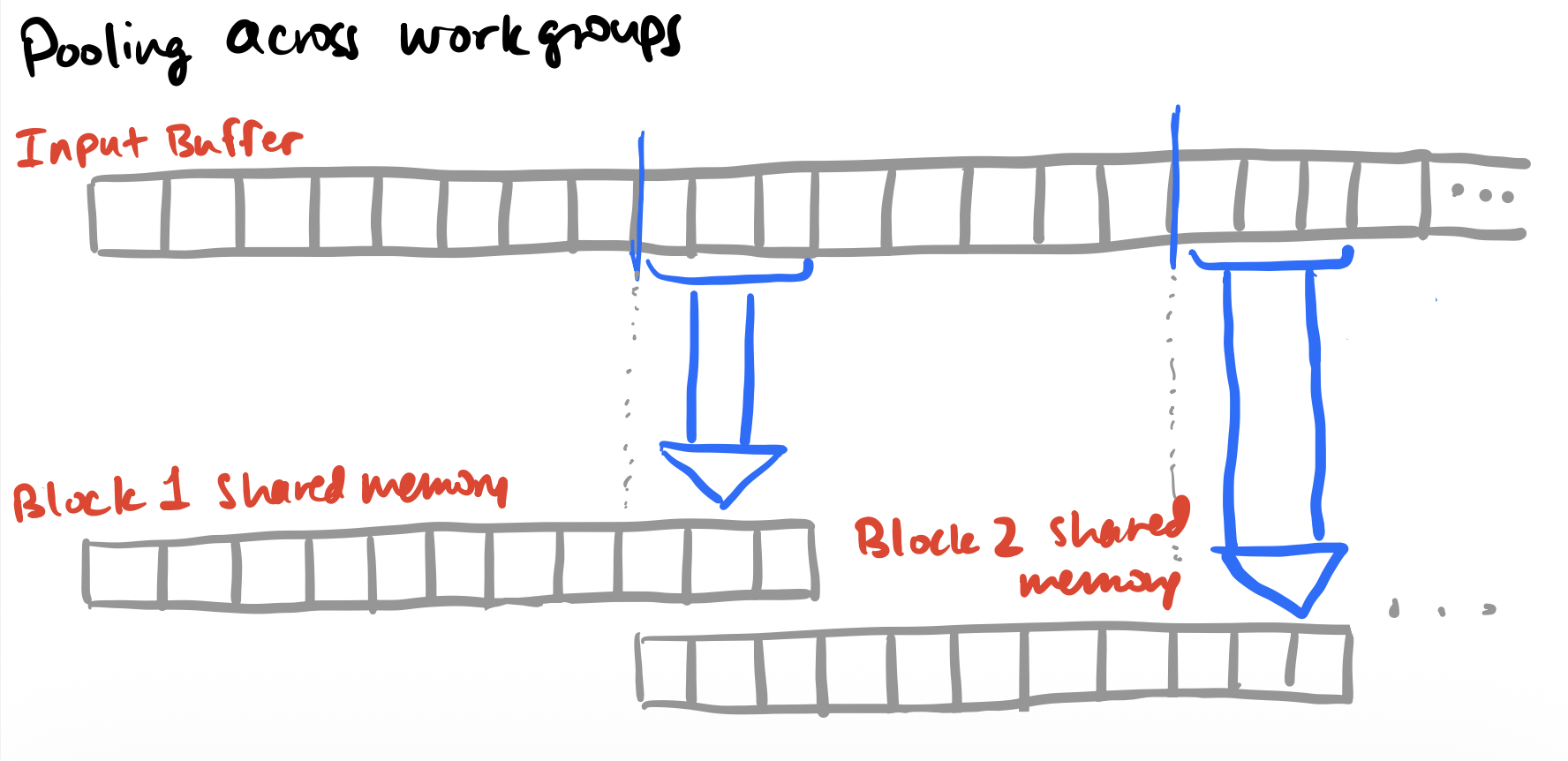
- For handling values that spill over blocks, just yank the extra values and store them in shared memory for your workgroup ahead of time
Algorithms
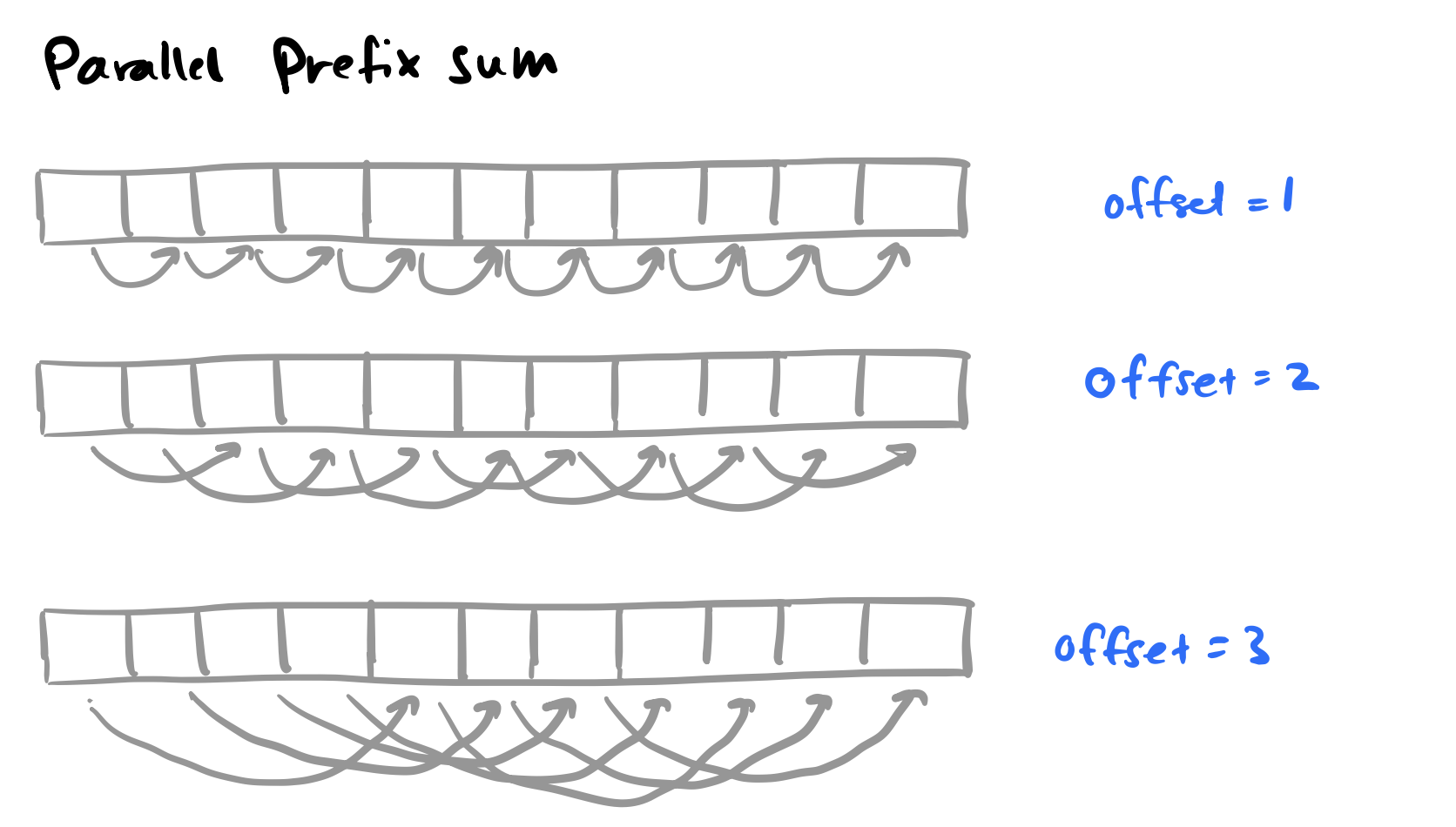
Problem 14: Parallel Prefix Scan