The problem
I had an interview question where I had to create a library to execute pipelines made of up stages. To keep things simple, let’s only consider the case where a stage takes in a single input and outputs a single output. These inputs and outputs could be of any type.
I templated the stage class with input and output types to look something like this (with some details removed):
template <class In, class Out>
class Stage {
    std::function<Out(In)> func;
    Out calculate(In arg) {
        // return func(arg)
    }

    StageKey get_key() {
        return key;
    }
};
Then, I wanted to store the stages in a map like:
std::unordered_map<StageKey, Stage> pipeline_stages;
C++ maps are not like Python dicts, in that all keys and all values must be of the same type declared at compile time. This is since the elements in a container must be of the same size.
But Stage is a parameterized type! So a Stage<Token, ProcessedToken> is a different type than a Stage<Transaction, Balance>, and both cannot be stored in the same container, since they are of different sizes!
Then how do we store Stages in our map?
The solution
The solution is type erasure. We want to unify the different Stage<In, Out> values under a single interface that has no concept of the type parameters In and Out, and then somehow store this base type in a container while being able to fetch the parameterized type information when desired. How do we do this?
This is done in two steps. First, we must unify stages under a common interface that has no reference to In or Out types.
1. A type erased interface
We declare an abstract IStage class that defines an interface for Stages, but with no type information.
class IStage {
public:
    virtual ~IStage() = default;
    virtual StageKey get_key() = 0;
    virtual void calculate(Context &context) = 0;
};
We have to modify calculate() to no longer return an Out and no longer take an In. Otherwise this wouldn’t be type erased and we would still have the same problem!
So instead, we refactor calculate() to mutate an external Context which stores inputs and outputs of stages. Each Stage<In,Out>::calculate gets its own body containing its own any_cast<const In&> and its own call through func. The types move out of the signature and into the body. This way, our IStage can be free of types.
Then, we can implement Stage as a subclass of our interface class.
template <class In, class Out>
class Stage : public IStage {
    std::function<Out(In)> func;
public:
    void calculate(Context &context) override {
        // read input from Context
        // calculate func
        // write output to Context
    }

    StageKey get_key() override {
        return key;
    }
};
2. Store pointers to concrete types
Now that we have a type-erased base class IStage, we can store stages in our map like
std::unordered_map<StageKey, IStage> pipeline_stages;
But we can’t access any of our concrete method implementations, since our values are of an abstract class type! Even if we instantiate a Stage<In, Out> and store it as an IStage in the map, all the data associated with Stage<In, Out> has been sliced off when it gets stored in the map. This happens since a container needs to store elements of the same size. So then how do we call the actual implementations we want?
The answer is to store instances of the concrete Stage<In, Out> derived types on the heap, and store upcasted pointers of type IStage in the map.
std::unordered_map<StageKey, std::unique_ptr<IStage>> pipeline_stages;
// takes type parameters on the way in, but erases types so downstream callers can just operate on `IStages`.
template <class In, class Out>
void add_stage() {
    std::unique_ptr<IStage> type_erased_stage_ptr = std::make_unique<Stage<In, Out>>();
    pipeline_stages.emplace(stage_key, std::move(type_erased_stage_ptr));
    // ...
}
Now, our pipeline_stages map stores type-erased pointers of type IStage that point to instances of the concrete derived class of type Stage<In, Out> on the heap!
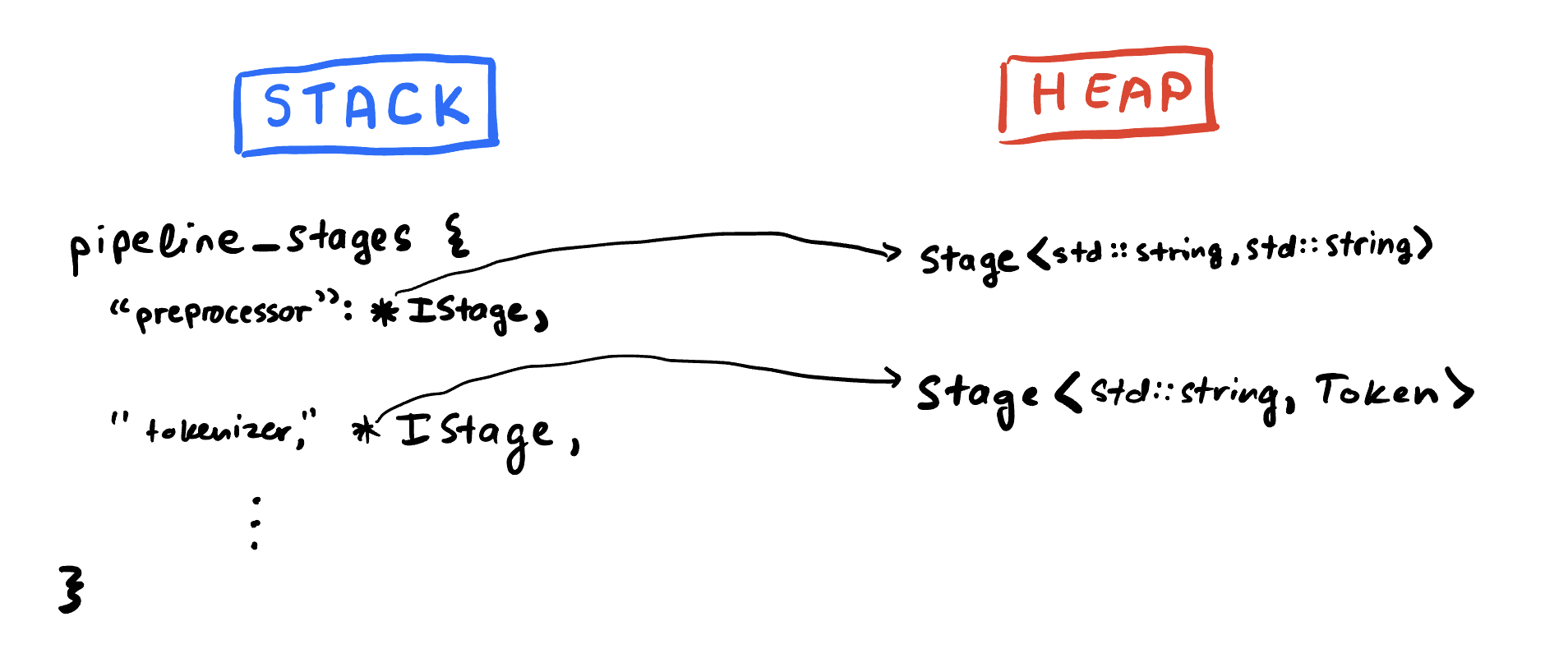
So when we call the interface methods on the IStage pointers, we are actually dynamically dispatching to the implementations defined in the Stage<In, Out> class!
std::unordered_map<StageKey, std::unique_ptr<IStage>> pipeline_stages;
const auto& type_erased_ptr = pipeline_stages.at(stage_key);
type_erased_ptr->calculate(ctx); // calls Stage<In, Out>::calculate for In, Out on the value that was placed on the heap during insertion!
So we have created a container that can store values of a parameterized type. Nice!
Other applications
Type erasure is useful beyond enabling heterogeneous containers.
It can help remove templated code. Functions that operate on stages that are not concerned about the type parameters of the stage can simply operate on IStage.
template <class In, class Out>
void validate_stage(const Stage<In, Out> &stage);
vs
void validate_stage(const IStage &stage);
The template parameters on the first code snippet would end up infecting the entire codebase! Not only are these templates tedious, but they are also unnecessary in many cases where functions do not need to know about the details of a parameterized type and just need to interact with an abstract version of such a type.
We can also use it to store unnameable types, such as lambda expressions which must be declared as auto to deduce the unnameable type:
auto f = [x](int i) { return i + x; }; // type is something like __lambda_7a3f_impl
In fact, this is how std::function is implemented to capture lambdas! We can’t just use std::function for the whole pipeline though, because it has type information in its signature. An std::function<Out(In)> still contains In and Out and needs to be type erased to store in a container.
We can also use this in cases where types are known at runtime but not compile time.
Downsides
We are trading compile-time type checking for runtime checking, since when we operate on IStages, the compiler doesn’t know about In and Out and therefore cannot do any checking on their usages.
We also call functions indirectly which incurs some vtable lookup overhead. Also, we cannot inline these functions and lose associated compiler optimizations, such as constant propagation. Additionally, each stage has to be allocated on the heap.
Conclusion
We saw how we can use type erasure to store heterogeneous types in the same container. We also saw how we can abstract away type parameters in a base type, and use dynamic dispatch to reach the concrete type’s implementation.
AI Disclosure
Code and blog post written by me, both lightly edited with Claude for correctness.